


Puffin Parenting!
- Jan 6, 2017
- 4 min read
Hello everyone, welcome to my first post of 2017! I hope you all had a fantastic New Year’s Eve and a cosy start to the new year on January 1st, tucked up in a duvet with water and paracetamol… Thankfully, I didn’t have the Hogmanay Hangover (Hogmanay is new year in Scotland) since we didn’t have a big night out, we in fact had a very cosy night in after returning from our mystery dinner at the lovely Italian. It was as magical as I had hoped, and thankfully Farren (my boyfriend for those not in the know) had no idea at all what I had planned! We had a lovely meal and made our way through a delightful bottle of the house wine before strolling home to enjoy the first moments of the new year in our new little home, sipping tea in our new dressing gowns (Christmas presents from my grandparents! So fluffy and so very snuggly <3).

Now, this blog post is actually about another present I received from my grandparents for Christmas, and something I didn’t know too much about beforehand. I knew a portion of what I’m about to tell you, but not the extent, so here we go!

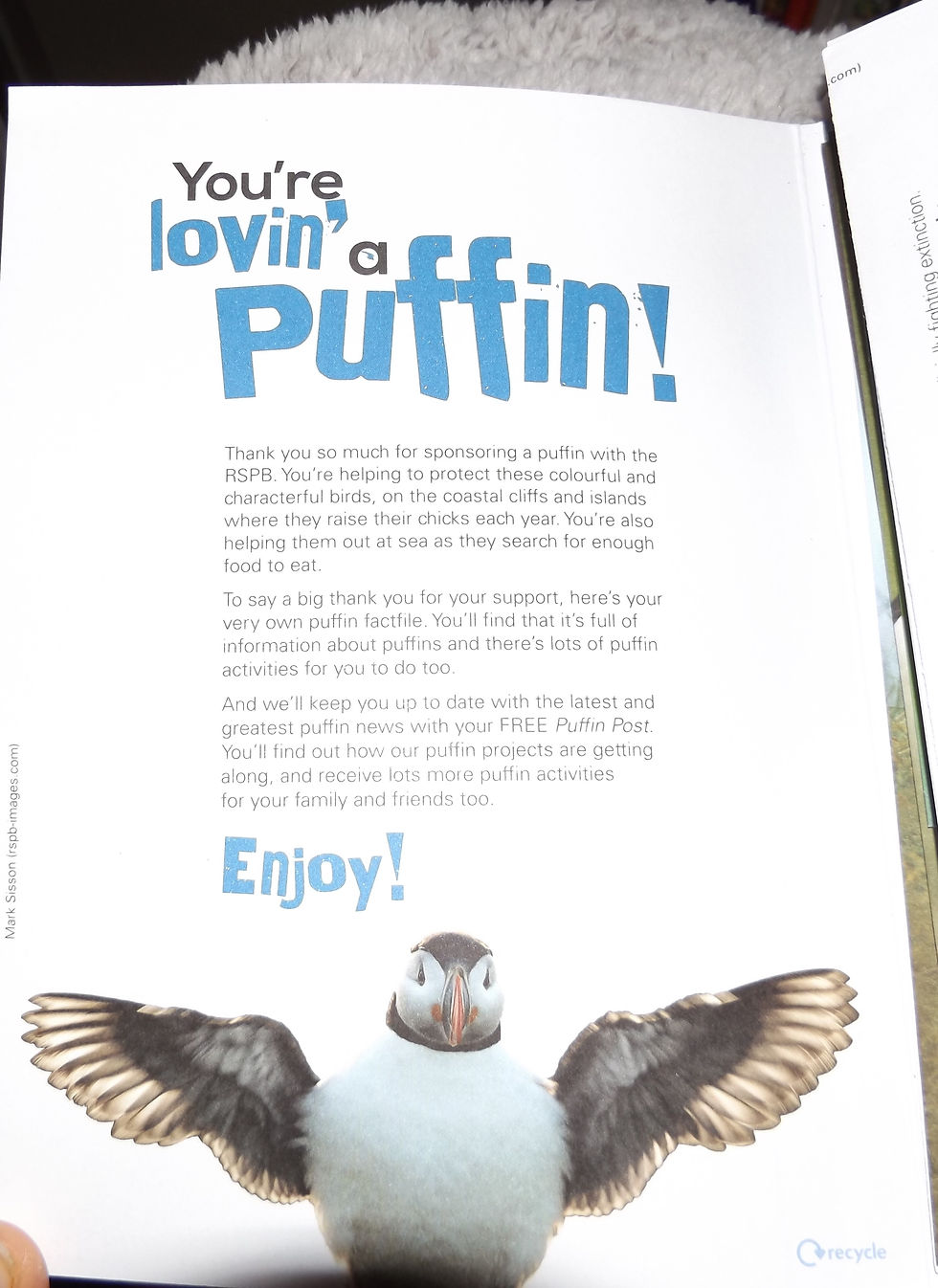
I am now the proud sponsor of a puffin! The RSPB offer the opportunity to anyone to sponsor a puffin for £3 a month, and this money goes towards the preservation of known popular breeding areas for puffins and helping to maintain rat-free areas for the puffins to nest and start new families. Life as a puffin sure isn’t easy, and it’s actually a lot more of a tricky life than I initially knew. Atlantic puffins are actually now registered as an endangered bird, with puffins facing the same level of extinction as the african elephant and lion, and more endangered than the humpback whale. The reason for this is a combination of limited food sources and puffin chicks (or pufflings as they are more adorably sometimes called) being killed/eaten by rats inhabiting puffin nesting areas. Puffins mate for life, meeting up with their puffin partner in the same location every year to mate and produce offspring, but with only one egg per puffin pair a year, if this puffling doesn’t survive then the pair have to wait until the next year to try again. Puffins make their nests on the ground, either a burrow dug into the ground or amongst rocks. This is why the nests are so easily accessible by rats. However, when (hopefully) the egg hatches and a puffling is born (and is not eaten by nasty bad guy rats), then both parents take it in turns to find food for their new baby, which needs feeding up to seven times a day. Puffins primarily eat small fish such as sandeels and other similar fish, but due to climate change and warmer seas, these fish are less plentiful and the puffins have to travel further and further to find food. Puffins spend the majority of their lives out on the open ocean, either flying or floating over the vast seas. Once a year, they all congregate back to their native lands to find their puffin partner, in order to mate and breed. The mysterious thing about puffins though, is that scientists have yet to work out how they navigate. However, it isn’t all doom and gloom being a puffin, they are extremely social creatures and form massive colonies, the largest known being a colony of 4 million puffins! They have many intricate body languages that communicate different emotions and signals to their fellow puffins, such as tucking their beak to their chests and moving past another puffin's burrow to demonstrate that they are passive, or puffing (puffin-g...is there a hidden pun there perhaps?) out their chests, spreading their wings, stamping its feet and opening its beak to look fearsome and frightening. They can also reach incredible flying speeds of up to 55mph, their wings beating up to 400 times a minute. The life span of a puffin is usually around 20 years, which is a lot longer than I had originally thought!


So as you can see, it is a very tricky business being a puffin! As such, I am very excited to tell you that I am now personally sponsoring one, and am very glad to help the puffins in any way that I can, as clearly, I am a big puffin fan! Until this incredible gift, I didn’t know that puffins faced such hardships, I knew they were endangered but not to the extent that they are, and I feel very strongly about it. (I am not one to preach and that’s not what I’m trying to do, so if this comes across as preachy in any way, please know that isn’t how I intended it.) I hope you learnt something about puffins reading this and if there’s anything I haven’t mentioned here that you do know, please leave it down in the comments below - they are truly fascinating creatures and I’d love to know more about them!

Now, being a Theoretical Physics graduate, (and generally just a bit pedantic and nerdy about these sorts of things) I couldn’t write anything with facts in it without leaving some references. These references are things I just perused in general and picked up finite figures from, but if you are interested to know more then I’ve left them linked below the main post. The other thing I’d like to mention about this week’s post is this - how pretty are the pictures? Aren’t they nice? (Except the ones of us in dressing gowns, that was a shameless phone selfie) I took them with my new camera and the quality is so scrummy, I can’t cope. I haven’t yet actually ventured out with my camera (I’m too scared to take it outside cause I’m a clumsy fool and it’s so fancy and cool) but I will soon and then you can marvel at even nicer pictures! (And not just those of my sponsor pack that I took whilst sat on the sofa in my dressing gown…) Anyway, thank you again so much for reading, and I’ll see you next week! Rachel x

https://oceanwide-expeditions.com/to-do/wildlife/puffin https://www.rspb.org.uk/birds-and-wildlife/bird-and-wildlife-guides/bird-a-z/p/puffin/ https://birds.knoji.com/puffins-facts-about-puffins-pictures-how-you-can-help/ https://www.rspb.org.uk/join-and-donate/donate/appeals/adopt-a-puffin/


Comments